SELMA, Ala — Some stories stop you in your tracks — not because they’re breaking news, but because they remind you why storytelling matters in the first place.
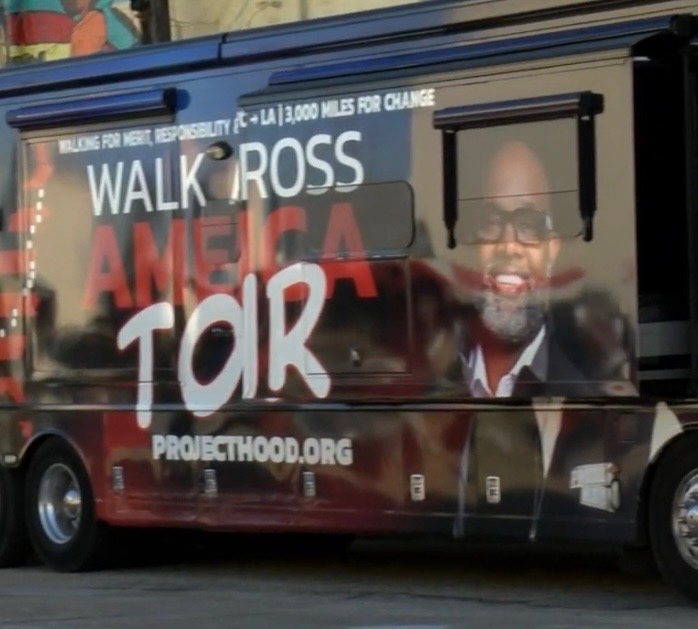
On Martin Luther King Jr. Day, I was covering another story for a station when I heard music coming from around the corner. Everything in me was tired — I wanted to go home and edit. However, something stopped me and said go over and see what it’s about. It could have been the free food they were offering, lol, who knows. But thank God I did because I got to meet Pastor Corey Brooks, the founder of Project H.O.O.D. (Helping Others Obtain Destiny), and hear all about his mission. As he served the community of Selma ribs and chicken he talked to be about Walk Across America — a journey that began September 1st in New York City and will end later in September of 2026 in Los Angeles.
Of all the days and places to stop, Selma was not lost on him.
“We couldn’t have planned it any better than this,” Pastor Brooks said. “To be here on Martin Luther King Day, in Selma — a historic place — it’s a major blessing.”
A Walk With a Purpose
Pastor Brooks isn’t walking across the country for attention. He’s walking for neighborhoods that feel forgotten — places that have been left behind, written off, or told that change isn’t possible.
Project H.O.O.D. is based on the South Side of Chicago, on a stretch of land once known nationwide for violence — a place many called O-Block, named after a young man, O.D. Perry, who was shot and killed. Gangs kept the name alive for years.
Pastor Brooks decided to keep the “O” — but redefine it.
Now, it stands for Opportunity Block.
“We believe that every block in America can make a comeback,” he said. “What we’ve done on the South Side of Chicago can be done anywhere.”
From One of the Most Dangerous Blocks to a Place of Hope
Project H.O.O.D.’s mission is rooted in transformation — not waiting on systems to change, but empowering communities to work together and rebuild from within.
That work includes a $47 million community center focused on leadership development, economic opportunity, and long-term stability. So far, more than $40 million has already been raised, with the goal of building the center debt-free.
“If we can do this on one of the most dangerous blocks in America,” Brooks said, “then surely it can be done here in Selma.”
Why Selma Matters
Selma isn’t just a stop along the route — it’s symbolic.
In recent weeks, the city has been grieving after the tragic loss of a young man to gun violence. Pastor Brooks says that pain is familiar — and it’s exactly why he believes his voice is needed in moments like this.
“That’s the voice God has given me,” he said. “To speak hope into situations where people feel like they don’t have the power to change things.”
Standing in Selma on MLK Day, Brooks spoke about legacy — not just remembering Dr. King’s dream, but continuing it through action.
“To follow in the footsteps of Dr. King and continue giving people hope — that’s what this is really about.”
A Dream Bigger Than One City
When asked about his own dream, Pastor Brooks didn’t hesitate.
“My dream is to transform that neighborhood on the South Side of Chicago — to build leadership and economic opportunity — and to show people that no matter how bad a neighborhood gets, it can still be changed.”
That belief — that change is possible, that collaboration matters, and that communities don’t have to wait to be saved — is the heartbeat of Project H.O.O.D.
And for a moment, on Martin Luther King Jr. Day, that heartbeat echoed through Selma and through me. His story inspired me. It showed me that whatever you want in this world you can do it. You just have to be passionate about it and others will follow.
I am so glad I stopped, I ended up leaving without the food, but with so much more — hope.